
AI content Generation
Error Reduction Rate
Production Proven
Putting the “flow” back into Life Science Workflows.
The Quartica MARS Platform helps life sciences teams create, connect, and govern the critical information they use every day with AI document writing, individualized workflows, source traceability, and human review built in.
Quartica MARS: the document co-authoring and workflow management all-in-one AI platform built for Pharma
One Platform. Zero Silos. Smarter Compliance.
Connects documents, source information, workflows, reviews, and approvals across functions so teams can reuse trusted, governed content with confidence throughout the enterprise. Documents become living assets that drive consistency and efficiency instead of recreating content across disconnected systems and handoffs.
Reduces Risk and Improves Efficiency
Connects information across departments, vendors, and systems without extensive data preparation or standardization. AI-native authoring, automated updates, validated workflows, and an audit-ready platform help teams reduce manual effort, improve consistency, lower compliance risk, and cuts document production time by up to 55%.
Built by Pharma experts, for Pharma experts
Built by pharmaceutical technology and process specialists, Quartica MARS has been deployed by leading pharma organizations for more than 7 years with consistently high adoption rates. Its purpose-built AI achieves a 4.7 out of 5 LLM benchmark score, delivering trusted performance for complex cross-functional workflows.
Enterprise-Wide, Suite, or Modular Solutions for Life Sciences
Quartica MARS is an intelligent document ecosystem that reduces production time and risk while restoring clarity and control to complex regulated workflows. Feel confident in the defensibility of your work knowing it’s designed specifically for the evolving world of Life Sciences.
Enterprise-Wide Solution
An enterprise-wide deployment of Quartica MARS brings documents, workflows, data, and compliance into a single validated ecosystem designed specifically for Life Sciences. Instead of disconnected tools and fragmented handoffs, teams work from one intelligent regulatory environment that improves consistency, accelerates collaboration, and reduces operational risk across the full document lifecycle.
- Unified authoring, workflow, and audit readiness
- Cross-functional alignment in one validated system
- Faster drafting with fewer manual handoffs and errors
- AI-native workflows built for evolving regulatory complexity
Quartica’s modular solutions provide powerful value for focused use cases or phased adoption strategies, but when organizations need enterprise-wide clarity, governance, and scalability, a connected platform approach helps teams move faster with greater confidence in the defensibility of every submission.
Clinical & Medical Writing Suite
Automate clinical authoring and streamline parallel activities by reusing it in different contexts for multiple assets and therapeutic areas across protocols, amendments, ICF, and study reports, with a uniform flow between upstream and downstream systems in compliance with industry authoring standards.
Regulatory Affairs Suite
Automate core operations for regulatory submission documents, CMC, Ad/Prom, and others, including planning, authoring, reviews, approvals, publishing, assembly, quality checks, and distribution in compliance with regulations, rules, and guidance.
Pharmacovigilance/Safety Suite
Drive faster, smarter PV operations with the only platform built to manage workflows and co-author PV documents across your entire department. Quartica MARS’s modular design lets you scale impact with each module adding enhanced automation, collaboration, and ROI.
Learn more about some of our Pharmacovigilance/Safety Suite modular solutions:
Manufacturing & Quality Suite
Automate, standardize, and fit-for-purpose product manufacturing templates with action item descriptions, process parameters, and results from operations, with the ability to look at any point in the chain, backward or forward, and identify related items.
Learn more about some of our Manufacturing & Quality Suite modular solutions:
See the Quartica MARS AI Platform in Action
Our client’s internal case studies show that MARS with human-in-the-loop delivers 5x efficiency by automating tasks, reminders, and collaboration, and co-authoring first drafts, all while maintaining global compliance. It’s the only complete, modular platform that scales at your pace.

60%-90%
Generation

>50%
Saving

>90%
Error Rates

99%
Compliance
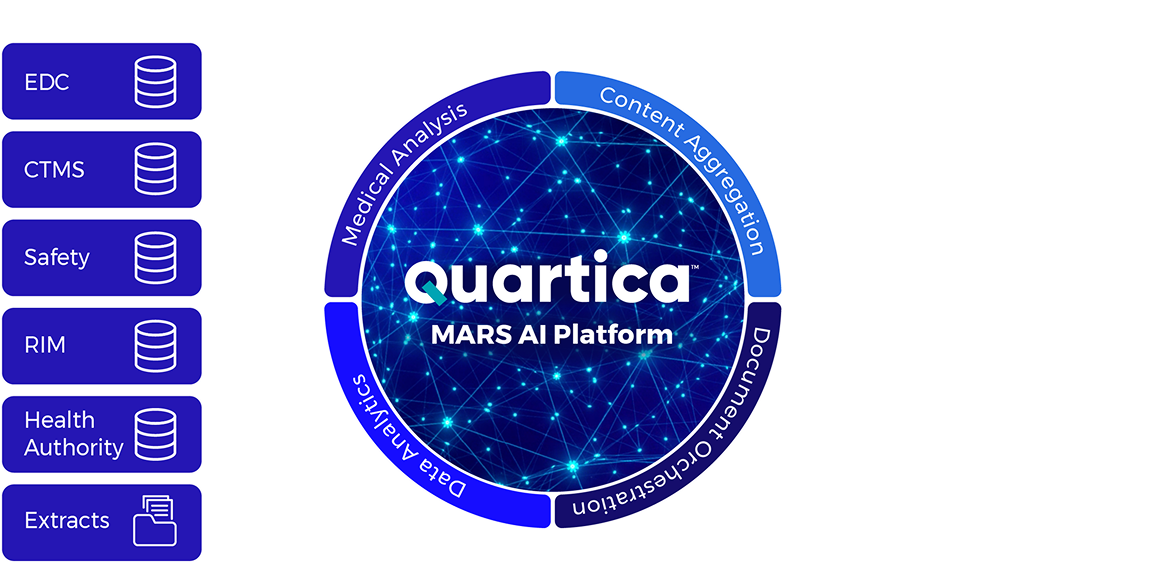
MARS - The AI Content Generation Platform for Life Sciences
MARS - The AI Content Generation Platform for Life Sciences
Explore Resources and Insights written for the reality of Life Sciences.
Our Champions Speak
We haven't seen another platform apply AI to authoring this effectively. Instead of simply accelerating administrative work, MARS helps teams produce better scientific content while maintaining compliance and oversight.
You can tell the platform was designed by people who understand PV. Instead of forcing us to change how we work, it supports the way our teams already manage regulated information. This combination of domain and technological expertise is difficult to find.
Many AI products still feel like pilots or demos. MARS is a mature, validated, platform already in use at major pharma companies and CROs. This plus the auditability, governance, and quality controls gave us confidence that the platform could support our real-world operations.
Quartica MARS is clearly the future of document writing for biopharma companies. This is certainly the way to go and how to write aggregate reports.
We've spent years evaluating solutions that piece together authoring, document management, and tracking. MARS unifies them in a single platform, eliminating manual handoffs and disconnected processes. Instead of being passed around through email and shared drives, documents live within the collaborative workflow, keeping everything connected, traceable, and validated from draft to approval.
We have been searching for a solution for our automated aggregate reporting needs for 3 years and were unable to find one until we discovered MARS, which has exceeded our expectations.
What immediately stood out was that MARS wasn't another legacy platform with AI added later. AI is embedded into the platform and the workflows from the ground up, which makes the experience fundamentally different. It feels purpose-built for regulated industry rather than a generic enterprise solution trying to adapt.
We had received an audit finding by the MHRA and needed to resolve the finding to satisfy an internal commitment. Quartica was able to implement MARS to meet our internal commitment and generate one-click reports for auditors which were very useful in audits and inspections.
Frequently Asked
Questions
What problems does Quartica MARS solve across pharmacovigilance, clinical medical writing, and regulatory functions?
Quartica MARS addresses the fragmentation of content, data, and workflows across safety, clinical, regulatory, and quality teams. It enables regulated documents to be created, maintained, and updated from shared, traceable content rather than recreated repeatedly in siloed systems. By unifying AI-assisted authoring, workflow orchestration, review, governance, and compliance controls in a single platform, MARS reduces rework, coordination overhead, manual reconciliation, and audit risk. This allows organizations to scale regulated content output without proportionally scaling headcount.
How is the Quartica MARS platform different from traditional document management or medical writing tools?
Traditional document management systems focus on storing, routing, and approving finished documents. Many medical writing tools focus on drafting individual sections or documents in isolation.
Quartica MARS is different because it is content-centric and workflow-driven. Scientific, safety, clinical, and regulatory knowledge is structured, traceable, reusable, and governed across documents and processes. AI is embedded into authoring, review, maintenance, and quality workflows not added as a disconnected writing assistant.
This allows teams to move beyond static documents toward connected, governed content workflows where source data, decisions, versions, approvals, and downstream documents remain linked and auditable.
How does the Quartica MARS Platform use AI in regulated life sciences without compromising compliance or audit readiness?
Quartica MARS applies AI within clearly defined intended uses, risk boundaries, and human-in-the-loop controls. AI supports drafting, analysis, summarization, content reuse, and maintenance, while human accountability is preserved at decision points that carry regulatory, medical, or compliance risk.
MARS is designed as a closed-loop, validated platform where AI-assisted outputs remain traceable to source information, model activity, user review, version history and approval decisions. This gives organizations a governed framework for using AI in regulated life sciences workflows without relying on opaque automation or disconnected external tools.
The result is responsible AI adoption with audit trails, review controls and operational governance built into the workflow from the start.
How does Quartica MARS support PBRER, PSUR, DSUR, and aggregate safety report authoring and how is it different from a safety database?
Safety databases such as Argus, ArisG, or other ICSR systems manage individual case safety reports and generate line listings, tabulations, and data outputs used in aggregate safety reports. Quartica MARS addresses a different and complementary challenge: authoring, maintaining, reviewing, and governing the full narrative report.
Quartica MARS can ingest structured outputs from safety databases and other source systems, combine them with approved prior content, literature, signal assessments, exposure data, regulatory actions, and supporting evidence, and generate 60–90% complete first drafts of PBRERs, PSURs, DSURs, IND Annual Reports, and related aggregate safety reports.
Human medical review, iterative editing, source traceability, version control, and approval workflows are built into the platform. The result is a governed, traceable, submission-ready report not just an appendix or data output.
Is Quartica MARS aligned with CIOMS XIV and emerging responsible AI expectations for life sciences?
CIOMS XIV provides one of the most detailed life-sciences frameworks for responsible AI, with a specific focus on pharmacovigilance. In the absence of equally detailed AI guidance across every life-sciences domain, its principles are increasingly relevant beyond PV, including clinical medical writing, regulatory operations, and other regulated content workflows.
MARS is designed to support responsible AI use through risk-based controls, human oversight, transparency, traceability, data privacy, fairness, and governance. AI operates within defined intended uses and risk boundaries, while human accountability is preserved at decision points that carry regulatory, medical, or compliance risk.
AI-assisted outputs in MARS remain traceable to source information, model activity, user review, version history, and approval decisions. For organizations navigating CIOMS XIV, the EU AI Act, and broader responsible AI expectations, MARS provides a validated, governed foundation for using AI across regulated life-sciences workflows.
How does Quartica MARS support clinical medical writing, protocol authoring, and ICH M11 / CeSHarP?
Quartica MARS supports clinical medical writing workflows for protocol development, protocol amendments, synopsis, investigator brochures, informed consent forms, clinical study reports, subject narratives, lay summaries, and related clinical documents.
As the industry transitions from traditional protocol templates toward ICH M11 / CeSHarP structured protocol expectations, MARS provides a governed authoring environment where protocol content can be structured, version-controlled, traced across amendments, and reused across downstream documents such as ICFs, CSRs, and regulatory summaries.
For sponsors and CROs implementing ICH E6(R3) expectations for technology-enabled clinical processes, MARS supports documented oversight, data integrity, workflow governance, and auditability across clinical medical writing activities.
How does MARS support regulatory writing, CTD authoring, and submission content workflows?
MARS supports regulatory writing workflows by helping teams generate, review, reuse, and govern content for CTD sections, clinical and nonclinical summaries, labeling documents, CMC impact assessments, health authority responses, and related submission content.
Rather than treating each submission document as a standalone file, MARS connects regulatory content to source information, prior approved text, safety data, clinical documents, quality inputs, review decisions, and approval history. This helps reduce manual reconciliation, improve consistency, and preserve traceability across submission-ready content.
How does Quartica MARS connect pharmacovigilance, clinical medical writing, regulatory, and quality content across functions?
Most life sciences organizations maintain separate systems, teams, and document repositories for pharmacovigilance, clinical medical writing, regulatory affairs, and quality. The same information – product safety profiles, benefit-risk assessments, study data, commitments, labeling decisions, quality events, and regulatory history is often recreated manually across functions, creating inconsistency, rework, and audit risk.
Quartica MARS operates as a governed content layer across these functions. Safety data that informs an aggregate report can also inform an RMP, PSMF, labeling update, benefit-risk assessment, or regulatory submission. Protocol content can remain traceable through amendments, ICFs, CSRs, lay summaries, and downstream regulatory summaries. Quality or CMC-related information can be connected where it has safety, regulatory, or benefit-risk relevance.
This cross-functional content reuse is governed rather than informal. Connections between documents are traceable, version-controlled, reviewable, and auditable, allowing teams to author once, govern centrally, and reuse with confidence across the product lifecycle.
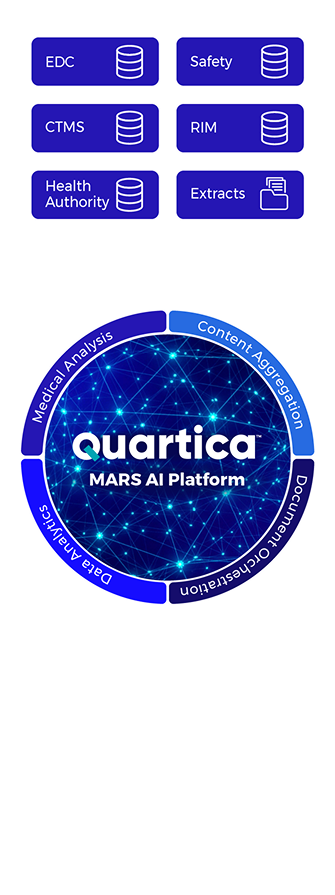
Can Quartica MARS work alongside existing systems such as safety databases, CTMS, RIM, Veeva, or document management platforms?
Yes. Quartica MARS is designed to coexist with existing enterprise systems, including safety databases, CTMS, regulatory RIM platforms, document management systems and Veeva Vault environments.
Quartica MARS integrates through structured data exchange, APIs, document ingestion, and configurable workflows rather than replacing core systems of record. This allows organizations to preserve prior investments while adding an AI-enabled content, authoring, workflow, and governance layer across Safety, Clinical Medical Writing, Regulatory, and Quality functions.
In practice, source systems continue to manage the records they are best suited for, while MARS connects the information needed to generate, maintain, review, and govern regulated content with traceability and auditability.
Which pharmacovigilance, clinical medical writing, regulatory, and quality documents does MARS support?
Quartica MARS supports a wide range of regulated life sciences documents across Safety, Clinical Medical Writing, Regulatory, and Quality functions.
In pharmacovigilance, MARS supports PBRERs, PSURs, DSURs, IND Annual Reports, RMPs, aRMM materials, PSMFs, PVA/SDEAs, SUSARs/DILs, Safety Management Plans, signal management reports, and related safety documents.
In clinical medical writing, MARS supports protocols, protocol amendments, synopses, informed consent forms, investigator brochures, clinical study reports, subject narratives, lay summaries, and related clinical documents.
In regulatory and quality workflows, MARS can support CTD content, clinical and nonclinical summaries, labeling documents, CMC documentation, CMC impact assessments, APQRs, quality documents, and other regulated content types.
Templates, workflows, governance controls, and source traceability can be configured to support organizational requirements, regional expectations, and new document types as needs evolve.
How does Quartica MARS support inspections, audits, and regulatory defensibility across pharmacovigilance, clinical medical writing, regulatory, and quality functions?
Quartica MARS is designed with auditability and regulatory defensibility as core principles. It maintains traceability between source data, generated content, user edits, review comments, decisions, approvals, and final documents across the regulated content lifecycle.
For AI-assisted workflows, MARS helps organizations show where AI was used, what source information supported the output, who reviewed or edited the content, and how the final decision was approved. Version history, workflow records, role-based access, and audit trails help teams explain not only what was produced, but how and why it was produced.
This supports inspection readiness across pharmacovigilance, clinical medical writing, regulatory, and quality processes by making evidence available through the workflow rather than reconstructed manually after the fact.
What does human-in-the-loop AI mean in practice for regulated life sciences workflows?
In MARS, human-in-the-loop AI means that accountability is intentionally built into the workflow. AI can assist with drafting, summarization, analysis, content reuse, update identification, and quality checks, but humans remain responsible for review, escalation, approval, and decisions that carry regulatory, medical, or compliance risk.
Human oversight is supported through role-based workflows, source traceability, version history, review comments, approval records, and audit trails. This allows teams to use AI at scale while preserving expert judgment, decision ownership, and inspection readiness.
Human-in-the-loop is not just a final manual check. It is an operating model for governed AI adoption in regulated environments.
Learn more about how Quartica MARS can help improve your document workflow.
Talk to our experts and see the platform in action or explore Quartica MARS.
